

Historic Philadelphia Walking Tour with Kids: Our Homeschool Field Trip
If you’re planning a family trip to Philadelphia, a guided walking tour is a wonderful way to explore the city’s rich history with kids!
We recently spent a day exploring historic Philadelphia with our two kids, ages 7 and 10, as part of a homeschool field trip.
We booked the Historic Philly for Kids Walking Tour through Step Into Philly Tours, and it turned out to be one of the highlights of our day!
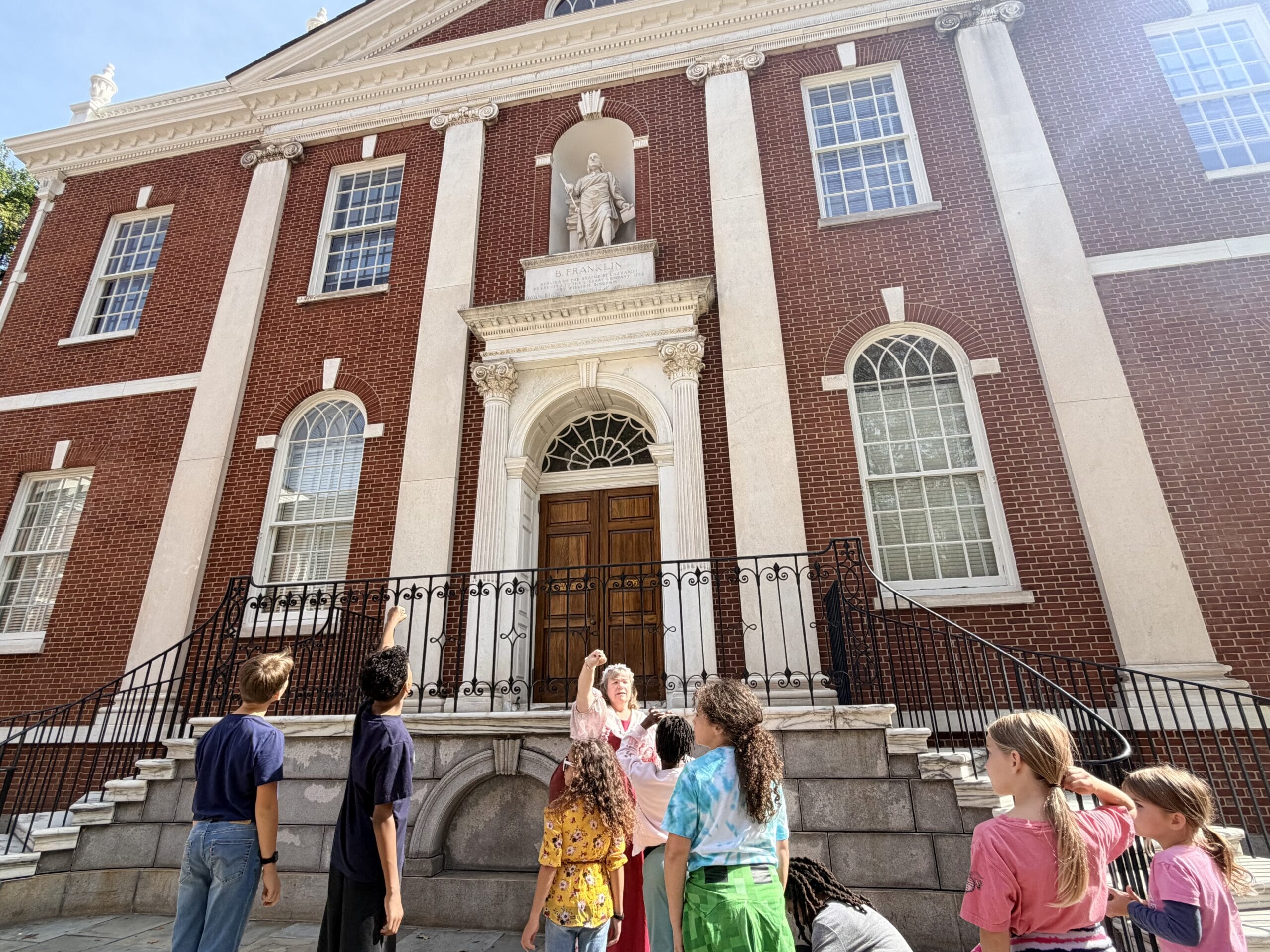
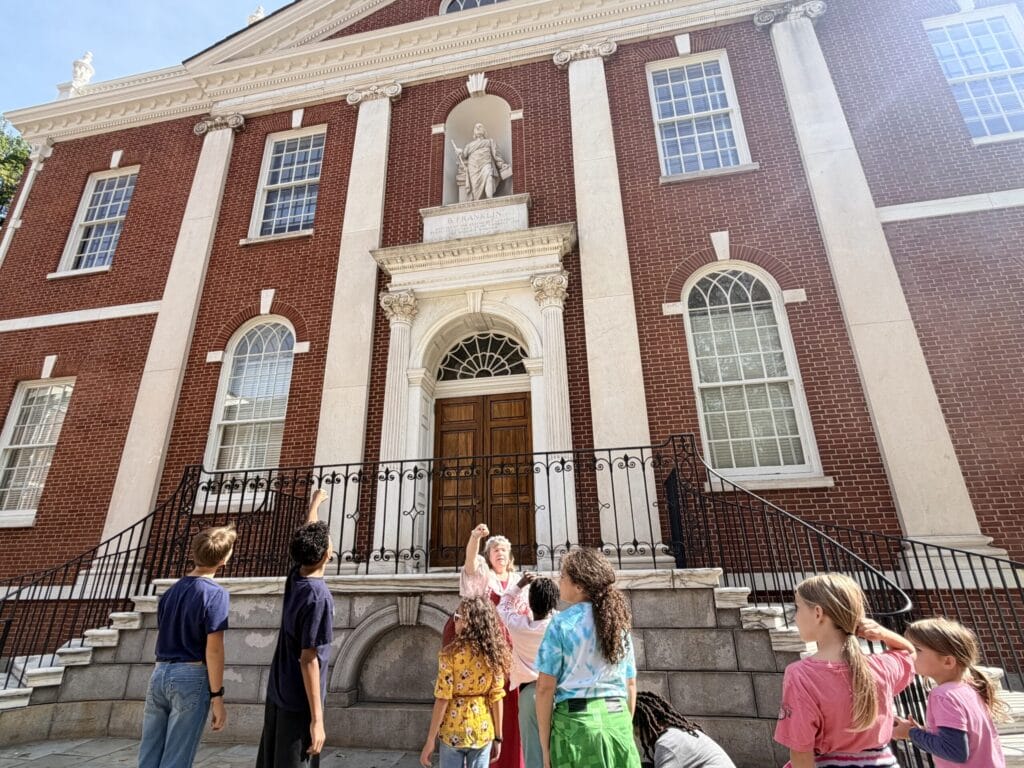
Our guide, Wendy, was an incredibly knowledgeable historian who had a wonderful way of bringing history to life. Rather than simply sharing dates and facts, she told stories that helped us imagine what life was really like in colonial Philadelphia.
Along the way, we visited Benjamin Franklin’s grave, the Betsy Ross House, Elfreth’s Alley, Franklin Court, Carpenters’ Hall, and several other important historic landmarks.
The tour lasted about 90 minutes, and we paid $25 per person. We felt it was absolutely worth every penny!
Here’s what we saw, what made the experience so special, and why I’d recommend this walking tour to other families.
Why We Chose a Kids’ Walking Tour
Since we homeschool, I love finding opportunities for my kids to experience the things they’re learning about in real life.
Reading about the American Revolution is one thing, but actually standing in the places where history happened is an entirely different experience.
Philadelphia has so many important historic landmarks within walking distance of one another, and I wanted the kids to understand the stories behind them.
Rather than simply exploring on our own, we decided to book a guided tour designed specifically for children.
I also liked that this particular tour was geared toward kids ages 5–12, which was perfect for our family.
While we could have visited many of these same locations on our own for free, I hoped that having a knowledgeable guide would make the experience more meaningful.
And I’m so glad we made that decision!
Our Experience with Step Into Philly Tours
I can’t say enough good things about our experience with Step Into Philly Tours!
Our tour guide, Wendy, was amazing. She was an incredibly knowledgeable historian, but what impressed me most was how wonderful she was with the kids.
She had a way of engaging with each child individually, asking questions, and explaining things in a way they could understand.
Rather than simply listing historical facts, she shared stories that brought colonial Philadelphia to life. She helped us imagine what everyday life was like in the 1700s, from how people lived and worked to the conflicts that divided neighbors and even families during the American Revolution.
One of my favorite examples was a story she shared at Elfreth’s Alley about two neighbors, one a Patriot and the other a Loyalist spy, who were married to sisters. Stories like this helped us understand that the Revolution wasn’t just about battles and famous historical figures. It affected ordinary people and their relationships, too.
Wendy also included thoughtful little touches throughout the tour to make it extra special for the kids.
At Benjamin Franklin’s grave, she gave each child a penny to toss onto it, following a local tradition. And at the end of the tour, she surprised each of them with a little gift!
These small gestures, combined with her engaging storytelling, made the experience even more memorable.
Another unexpected bonus was meeting a wonderful homeschool family on the tour!
One of the things I love about homeschooling is connecting with other families who enjoy learning and exploring together. It was such a nice addition to an already great day.
Overall, Wendy made history feel less like a lesson and more like a story we were experiencing together.
What We Saw on Our Historic Philadelphia Walking Tour
Benjamin Franklin’s Grave
One of our first stops was Benjamin Franklin’s gravesite at Christ Church Burial Ground.
Franklin is buried here alongside his wife, Deborah.
His grave can be seen through the cemetery’s iron fence, so you don’t necessarily have to enter the burial ground to see it.
There’s a long-standing tradition of visitors tossing pennies onto Franklin’s grave, inspired by his association with sayings about saving money and being thrifty.
Wendy gave each of the kids a penny to toss onto his grave, which I thought was such a thoughtful way to involve them in the experience!
Although the tradition has become popular over the years, the pennies have also contributed to damage to the historic gravestone.
Benjamin Franklin was much more than one of America’s Founding Fathers. He was also a printer, inventor, writer, diplomat, and scientist.
Seeing his actual burial place was a reminder that the historical figures we learn about were real people who lived and worked in the city we were exploring.
The Benjamin Franklin Statue Covered in Keys
Another interesting stop was a Benjamin Franklin statue outside a historic firehouse.
The statue, called Keys to Community, features a large bronze bust of Benjamin Franklin covered in keys!
It’s definitely not your typical historical statue.
The artwork is a tribute to Franklin, and the keys reference his famous electricity experiment.
It’s a fun landmark to see with kids because it’s so unusual. It’s also a great opportunity to talk about Franklin’s contributions beyond his role in American independence.
The Betsy Ross House
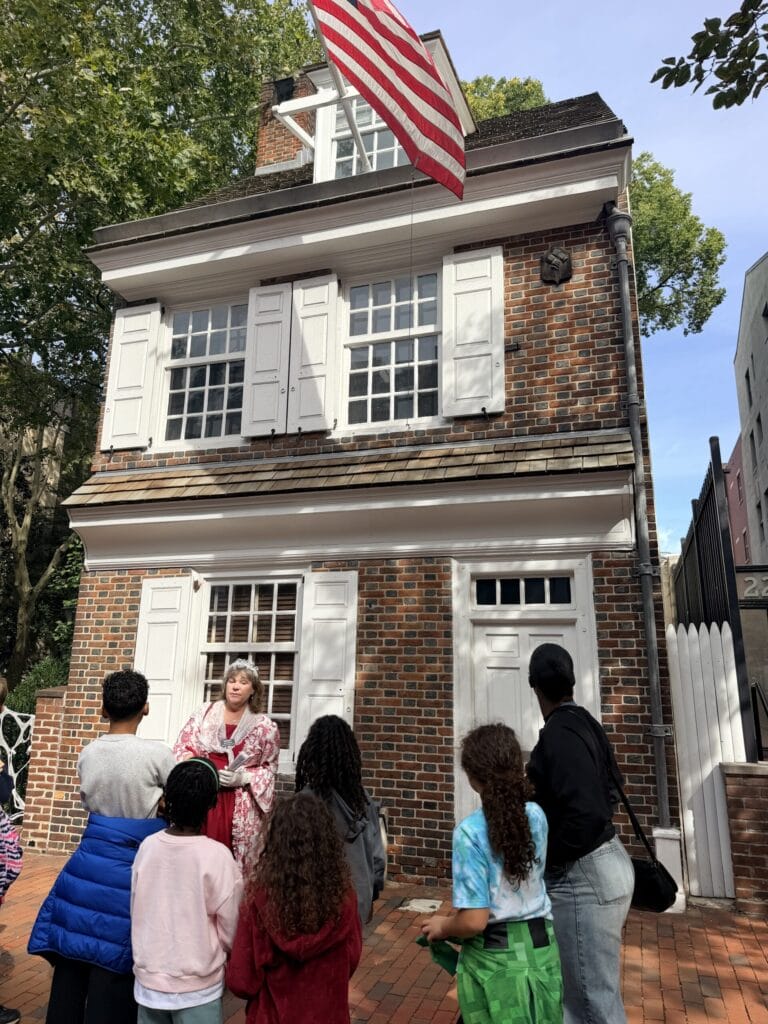
We also stopped outside the Betsy Ross House.
Betsy Ross is traditionally credited with sewing the first American flag, although historians continue to debate the accuracy of that story.
The house offers a glimpse into life in colonial Philadelphia, particularly for the tradespeople who lived and worked in the city.
I think it’s also a great opportunity to talk with kids about how historians separate documented facts from stories passed down through generations.
We saw the house as part of our walking tour rather than taking a separate tour of the interior.
If you’d like to go inside, you can plan an additional visit.
Elfreth’s Alley
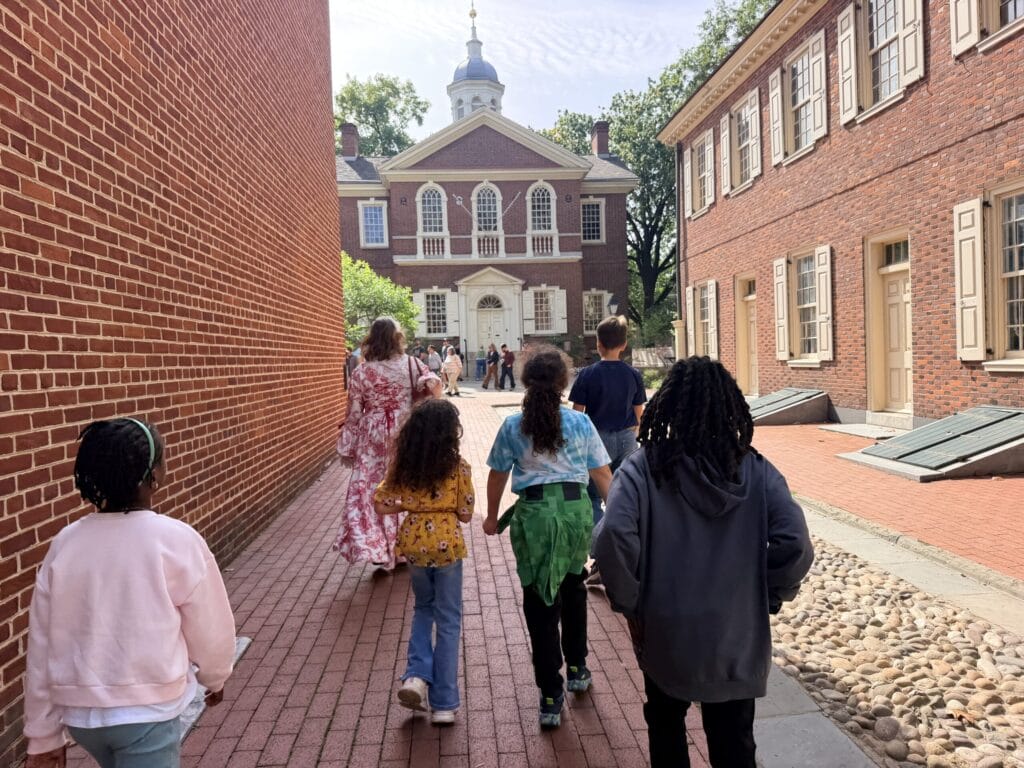
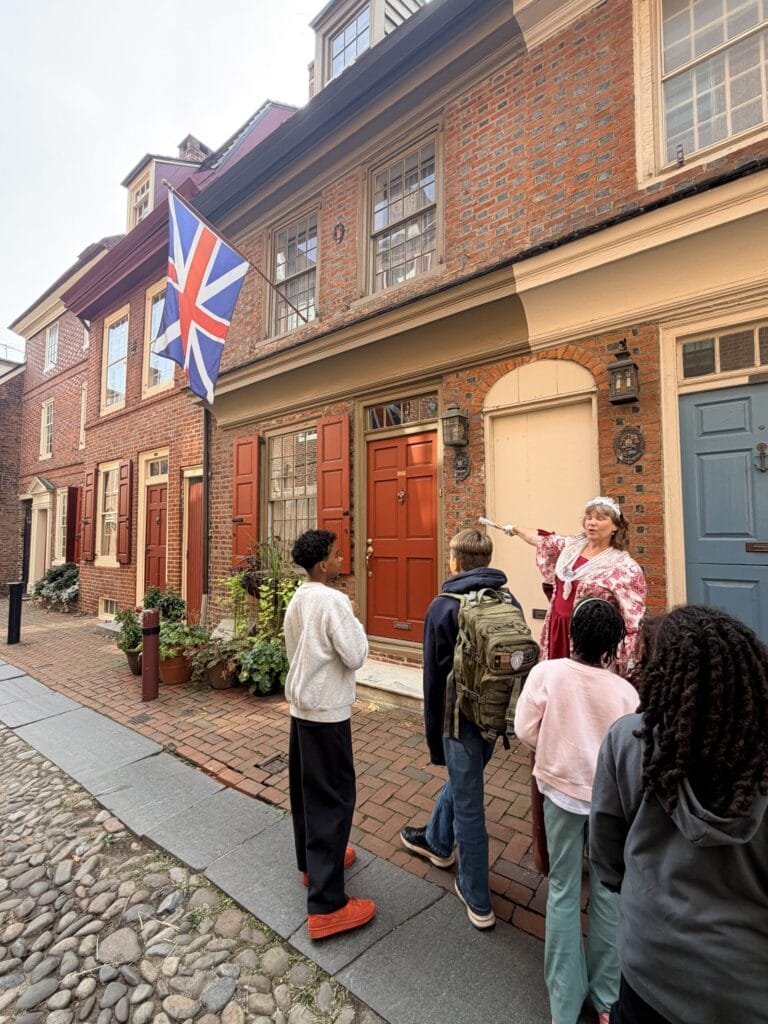
One of the most memorable stops on our walking tour was Elfreth’s Alley.
Dating back to 1703, it’s considered the oldest continuously inhabited residential street in America.
The narrow cobblestone street is lined with historic brick homes, and people still live in them today!
But what made this stop especially interesting was a story Wendy shared with us.
She told us about two neighbors who lived on the alley during the Revolutionary War. One was a Patriot who supported American independence, while the other was a Loyalist spy who supported the British.
And to make things even more interesting, the two men were married to sisters!
I loved this story because it helped us understand just how complicated life was during the Revolution.
We often learn about Patriots and Loyalists as two opposing sides, but it’s easy to forget that they were actual neighbors, friends, and family members.
Imagine living next door to someone who supported the opposite side of a war, especially when your families were connected through marriage!
Wendy did an amazing job painting a realistic picture of what life was like back then.
Instead of just seeing a street lined with old houses, we were able to imagine the people who lived inside them and the challenges they may have faced.
This was one of those moments that made me especially glad we had booked a guided tour.
Benjamin Franklin’s Printing Office
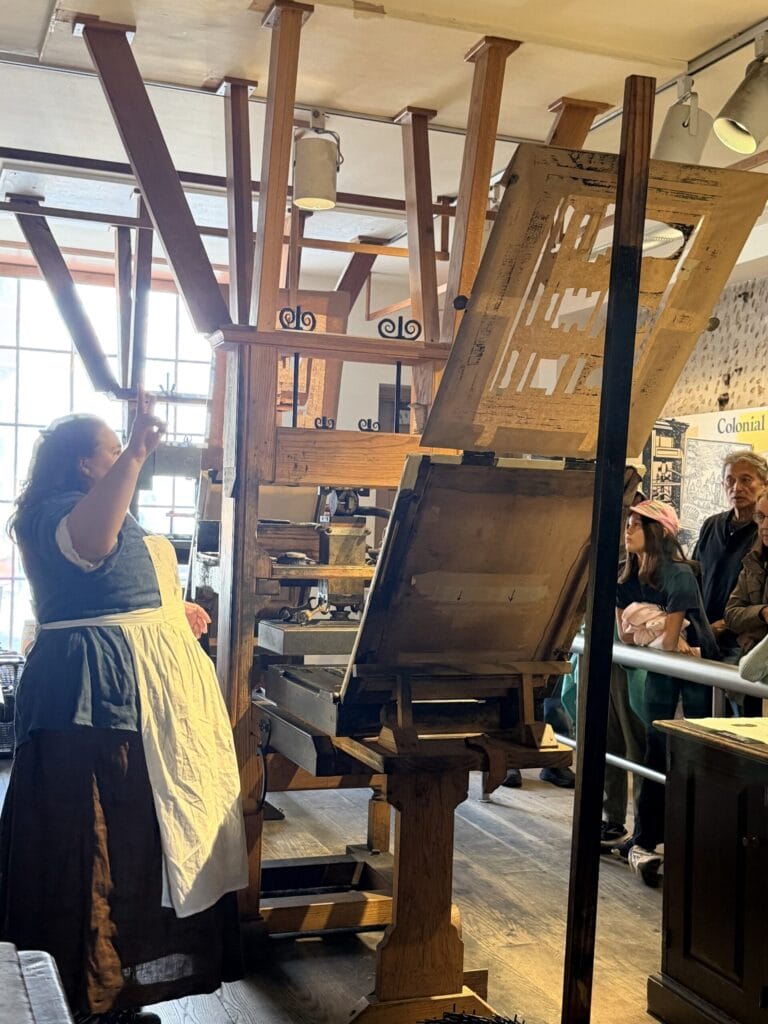
Another stop was the historic printing office at Franklin Court.
Before modern printing technology, producing books and newspapers was a much more involved process.
At the Franklin Court Printing Office, visitors can learn about how printing was done in the 1700s using movable type and printing presses.
Benjamin Franklin worked as a printer long before becoming one of America’s most famous Founding Fathers.
Printing also played an important role during the American Revolution. Newspapers, pamphlets, and other printed materials helped spread information and political ideas throughout the colonies.
I think this is a particularly interesting connection for kids because it’s easy to take reading materials for granted when we’re surrounded by books, computers, and printers today.
Benjamin Franklin’s Former Home
We also visited Franklin Court, where Benjamin Franklin once lived.
His original house no longer stands, but a steel framework known as a “ghost structure” shows where the building once stood.
You can also see archaeological remains of the home’s foundation.
I thought this was an interesting way to show the kids that not every historic building survives.
Sometimes historians and archaeologists have to use what remains to piece together what a place looked like hundreds of years ago.
Carpenters’ Hall
Another important stop was Carpenters’ Hall, where the First Continental Congress met in 1774.
Representatives from 12 of the 13 colonies gathered here to discuss their growing disagreements with Great Britain.
This meeting helped lay the groundwork for the events that eventually led to American independence.
It’s amazing to think that such an important event took place inside a relatively small building in Philadelphia.
For homeschoolers studying the Revolutionary War, this is a great opportunity to introduce some of the events that happened before the Declaration of Independence.
Independence Hall and the Liberty Bell Area
Our walking tour also took us through the area surrounding Independence Hall and the Liberty Bell.
Independence Hall is one of the most important landmarks in American history.
It’s where the Declaration of Independence was adopted in 1776 and where the United States Constitution was debated and signed in 1787.
Seeing these landmarks in person is a wonderful way to connect the people and events of the Revolutionary War to actual places.
We also visited Independence Hall separately during our Philadelphia field trip, so the walking tour was a great introduction to the area.
Is the Historic Philly for Kids Walking Tour Worth $25 Per Person?
Absolutely!
We paid $25 per person, bringing the total for our family of four to $100.
While there are plenty of historic landmarks in Philadelphia that you can explore on your own for free, I really think having a knowledgeable guide made a huge difference.
We could have walked past many of these same buildings ourselves, but we wouldn’t have learned nearly as much about the people who lived there or the stories behind them.
What made the experience especially worthwhile was Wendy’s ability to connect with the kids and bring history to life.
She kept them engaged and explained things at a level they could understand, rather than treating them like adults on a traditional history tour.
For us, that made the experience worth the extra money.
If you’re visiting Philadelphia with elementary-aged kids, I highly recommend the Historic Philly for Kids Walking Tour.
Tips for Taking a Historic Philadelphia Walking Tour with Kids
If you’re planning a walking tour through Old City Philadelphia, here are a few things I’d recommend:
- Wear comfortable shoes. You’ll be walking several blocks, including some cobblestone streets and uneven sidewalks.
- Check the weather. The tour takes place outdoors, so dress appropriately and bring sunscreen, jackets, or rain gear as needed.
- Eat beforehand. A 90-minute tour can feel much longer when the kids are hungry. Make sure everyone has eaten before you start.
- Bring water. Especially if you’re visiting during warmer weather.
- Use the bathroom before the tour. You don’t want to have to leave the group to search for a restroom.
- Book in advance. The children’s tour has a limited group size, so it’s a good idea to reserve your spots ahead of time.
- Don’t feel pressured to visit every building afterward. The walking tour is a great introduction to Philadelphia’s historic sites. You can always return to explore your favorites more thoroughly.
How to Book the Historic Philly for Kids Walking Tour
We booked our tour through Step Into Philly Tours.
Here’s some helpful information if you’re thinking about booking:
Tour: Historic Philly for Kids
Recommended ages: 5–12 years old
Duration: Approximately 90 minutes
Cost: We paid $25 per person at the time of our visit.
Meeting location: At the benches behind the Free Quaker Meeting House, 500 Arch Street, Philadelphia, PA.
Group size: Maximum of 16 participants.
Reservations: Advance booking is strongly recommended.
The tour takes place outdoors, so be sure to dress for the weather and wear comfortable walking shoes.
You can check current prices and available tour times on the Step Into Philly Tours website.
Make It a Full Philadelphia History Field Trip
If you’re planning a homeschool field trip to Philadelphia, you can easily combine a historic walking tour with other educational attractions.
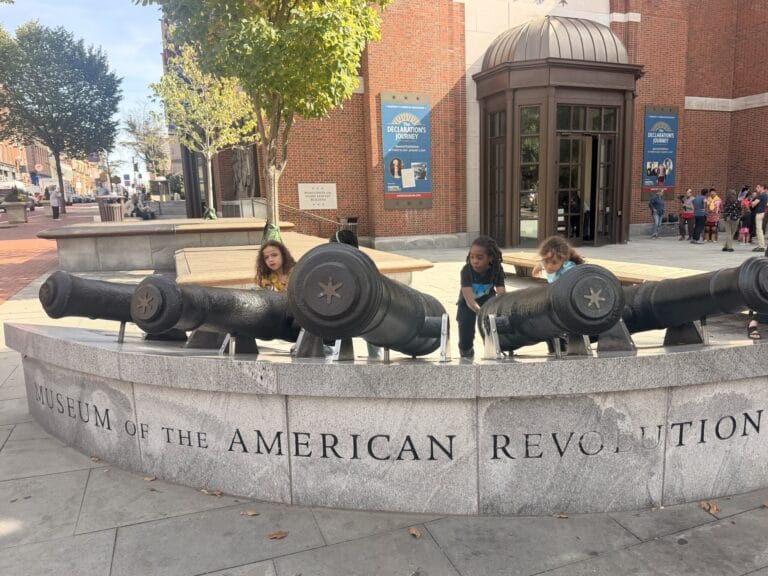
During our visit, we also explored Independence Hall and the Museum of the American Revolution.
At the Museum of the American Revolution, the kids enjoyed the children’s audio tours, scavenger hunt, and Revolution Place, a hands-on play area where they could dress up and pretend to live during colonial times.
One of the most memorable experiences was seeing George Washington’s original headquarters tent!
You can read more about our experience in our Visiting the Museum of the American Revolution with Kids article.
We also created a free Philadelphia Revolutionary History Field Trip Printable to help kids reflect on the important places they visited and what they learned.
If you enjoy incorporating real-world experiences into your children’s education, be sure to explore more of our homeschool ideas and resources.
Continue Learning After Your Walking Tour
One of my favorite things about homeschooling is being able to build on experiences like these after we get home.
A field trip doesn’t have to end when you leave the city!
Here are a few simple ways to continue learning about colonial Philadelphia and the American Revolution:
- Have your kids choose one historic landmark they visited and research its history.
- Create a timeline of important events leading up to the American Revolution.
- Learn more about Benjamin Franklin’s inventions and contributions to American history.
- Compare what life was like for Patriots and Loyalists during the Revolutionary War.
- Have your kids write or draw a picture about their favorite part of the walking tour.
You can also explore our Learning at Home activities for more ways to make learning hands-on and fun.
Sometimes the best learning happens when kids start asking their own questions!
Final Thoughts: Is the Historic Philly for Kids Walking Tour Worth It?
Absolutely! This was one of the highlights of our Philadelphia homeschool field trip.
While we could have explored many of these historic sites on our own, having Wendy as our guide made the experience so much more meaningful.
I especially appreciated how she helped the kids understand history through stories about ordinary people and what their lives were like during the Revolutionary War.
The little surprises she included along the way made the experience even more memorable, and meeting another homeschool family was an unexpected bonus!
For $25 per person, we felt the tour was extremely worthwhile.
If you’re visiting Philadelphia with elementary-aged kids, I highly recommend checking out the Historic Philly for Kids Walking Tour from Step Into Philly Tours.
It’s a fantastic way to make history come alive!