


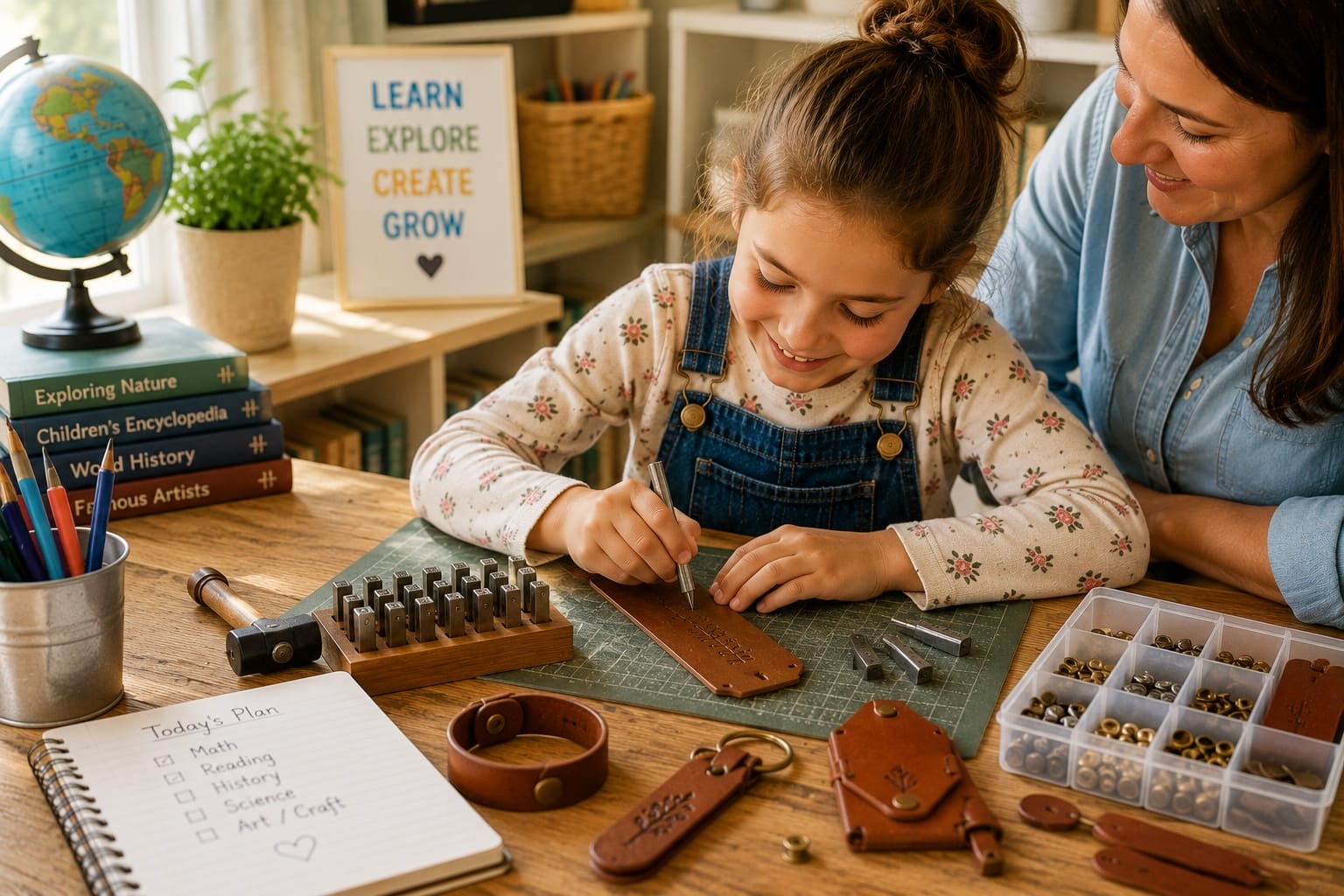
Why Homeschool Families Are Adding Craftsmanship to Their Learning Plans
(Image by Drouk from Getty Images Via Canva)
Some of the content in this post was provided by a contributor. We only share resources we think are helpful.
There is a quiet shift happening in homeschool households across the country. Alongside math curricula and reading logs, more families are carving out time for something older and more tactile: learning to make things with their hands.
Craftsmanship, once considered a trade-school subject or a hobby for retirees, is finding its way into lesson plans as parents recognize how deeply it supports children’s development. From woodworking to leatherwork to engraving, hands-on skill building is becoming a genuine educational priority rather than just a rainy-day activity.
Reasons to Teach Craftsmanship at Home
Homeschooling already gives families flexibility that traditional schooling cannot always offer. That flexibility opens the door to subjects that schools often cut first when budgets tighten, with shop class and art electives among the earliest casualties.
Craftsmanship fills that gap in these meaningful ways:
Fine Motor Development
Detailed handwork, such as engraving or carving, sharpens the same motor skills that support handwriting and precision later in life.
Problem-Solving Under Real Conditions
When a project does not turn out as planned, kids have to think critically about what went wrong and how to fix it.
Patience and Process Thinking
Craft projects rarely deliver instant results, which teaches children to value process over speed.
Math and Science in Context
Measuring materials, understanding pressure and surface tension, and estimating depth all become practical rather than abstract.
These are skills that transfer far beyond the workshop.
How Engraving Fits Into a Homeschool Curriculum
Engraving might not be the first craft that comes to mind when planning a homeschool year, but it is one of the most versatile and accessible options for beginners of almost any age.
Young Learners Can Explore Engraving
Unlike woodworking, which often requires significant space and larger tools, engraving projects can be completed in a smaller workspace with relatively simple equipment. Many families find that supervised engraving activities work well at a kitchen table or craft station, making them easier to incorporate into a homeschool routine.
As with any tool-based activity, children should always be supervised by an adult. Safety glasses, proper ventilation when working with certain materials, and age-appropriate tools are important considerations. Starting with practice pieces and simple designs can help build confidence while reinforcing safe habits from the beginning.
Variety of Materials That Make Great Projects
Engraving can be done on a surprisingly wide range of surfaces, which keeps things interesting as students progress:
Wood: Beginner-friendly and forgiving, it works great for name signs or decorative panels.
Leather: Adding a tactile, professional quality to finished pieces, it pairs well with history or cultural studies.
Glass and Stone: Slightly more advanced than other materials, these surfaces are very satisfying for older students to work with.
Metal: A versatile option, it works well for personalized keychains, jewelry, or tools.
The variety means a single engraving tool can serve a family for years across many different projects and skill levels.
How to Choose the Right Starter Kit for Family Use
Not all engraving tools are created equal, and for homeschool families, the right choice matters. A tool that frustrates a beginner or breaks quickly can discourage the very enthusiasm you are trying to build.
What to Look for in a Beginner Engraving Pen
Variable Speed Control: This feature lets students adjust the intensity as they gain confidence with the tool.
Comfortable Grip: A well-designed handle is important for younger hands working on detailed projects over longer sessions.
Versatility Across Materials: A tool that only works on one surface limits long-term use and creative growth.
Safety Design: Look for tools with protective features and clear safety instructions suitable for supervised use with children.
For families specifically exploring leather projects, leather engraving kits are a natural starting point. Leather is durable, shows detail beautifully, and produces finished pieces that look polished even when made by a newcomer. A bookmark, a small wallet panel, or a personalized belt are the kinds of projects that give beginners an immediate sense of accomplishment.
Many families appreciate starter kits that include beginner-friendly instructions, multiple project options, and tools designed for ease of use. Choosing quality equipment can help reduce frustration and make the learning experience more enjoyable for both parents and children.
Integrating Craft Projects Into Weekly Lessons
The beauty of craftsmanship in a homeschool setting is how naturally it connects to other subjects. Rather than treating engraving as a standalone hobby, families can weave it into existing lesson plans.
Cross-Curricular Connections
History: Students can study ancient engraving traditions from Egyptian hieroglyphics to Viking rune carving, then try a simplified version of the same technique.
Language Arts: Having students engrave a word or phrase from a poem or story they are studying brings literature to life in a tangible way.
Geography: Creating engraved maps or cultural symbols from different regions adds a hands-on dimension to social studies lessons.
Entrepreneurship: Older students can design and produce small engraved goods to sell at a local market or online, learning basic business concepts in the process.
Keeping Sessions Structured Without Being Rigid
Craft time works best in homeschool when it has some structure but leaves room for creativity. A simple rhythm that works well for many families:
- Introduce the technique or material for the day (10 minutes)
- Review safety expectations and demonstrate proper tool handling (5 minutes)
- Practice on a scrap piece before moving to the real project (15 minutes)
- Work on the main project (30 to 45 minutes)
- Review and discuss what worked and what they would change (10 minutes)
This kind of intentional reflection turns a craft session into a genuine learning experience rather than just a fun afternoon.
The Long-Term Value of Raising Skilled Makers
Children who grow up making things develop a relationship with the physical world that is harder to cultivate through screen-based learning alone. They understand that objects have construction, that quality takes effort, and that creativity is not just about ideas but about the ability to execute them.
Craftsmanship also builds confidence in a very specific way. A child who has engraved a piece of leather, finished it, and gifted it to someone they love has completed something real. That sense of completion is deeply motivating and tends to carry over into other areas of their learning life.
Conclusion
As more families look for ways to raise capable, creative, and resourceful young people, craftsmanship deserves a permanent spot in the learning plan. It does not require a large budget, a dedicated room, or years of expertise to get started. With the right safety precautions, a good tool, and a little time set aside each week, homeschool families can introduce meaningful hands-on skills that encourage creativity, patience, and lifelong learning.